

Shoot on Sight - “The More You Shoot the better I Will Like You” (British Officer L-C.G.B.F. Smyth)
By Jim Hegarty
Penal Laws in Ireland
The discriminatory Penal Laws of the 17th and 18th century Imposed by the British Government on Irish Roman Catholics,were designed to secure Church of Ireland supremacy.The Laws succeeded In restricting Land Ownership, Education and Political Office.They were in fact an attempt to dehumanise the majority Catholic population.
These Acts forced thousands of young men with little formal education to seek employment within the British Army ranks. It is reported that during this period,in excess of forty per cent of all non commissioned British soldiers were in fact Irish.
Their well educated officers were mainly Anglo-Irish from Ascendancy families.With the outbreak of WW1 many joined for numerous reasons believing, in the freedom of Small Nations and the promise of Home Rule.It is reported that,Irish men over many war campaigns received the Victoria Cross for bravery, the highest award available in the British service.
A further darker side of the British Empire Authorities is that they were guilty of allowing Irish slaves to be shipped to the West Indies in great numbers as cheap labour (yes slaves but described as indentured servants).Being Irish they were treated badly and more severely than the African slaves.The Cromwellian officer Major -General William Brayne, who for a period was the Military Governor of Jamaica, (1656-1657) was concerned about their growing numbers and is reported as saying, “What if they should mutiny” ?
War of Independence
Since the Republic was declared and the War of Independence began with the ambush at Soloheadbeg in County Tipperary, everything possible had been done to disrupt the British administration.The brave young men and women of the Volunteers and Cumann na mBan were gaining valuable intelligence which allowed the IRA to raid Barracks,trains and homes obtaining guns,ammunition and ordinance which were in short supply.These successful raids enabled arms dumps to be built such as at The Laurels under the control of my father John Joe’s command.
Further disruption followed when Michael Collins, gave a nationwide order to burn RIC Barracks and Tax office records which were all carried out successfully.It was also the year that Irish Trade unionists called a National Strike for their Dockers and Railway- Workers,resulting in their members refusing to load or unload military cargo, railway men refusing to transport British soldiers or military equipment. This is often referred to as the Munition Strike. All of these actions caused havoc for the British administration in their attempts to peacefully govern Ireland.
British Army and
Black and Tans Run Riot
Cork City and County became a hot bed of activity and as a consequence
(like many other counties), became a very dangerous place to live. My father John Joe, Aunts Mamie and Nan were all Officers in H company of the Cork No 1.Brigade,
(The Hegartys of The Laurels).
Their home, The Laurels, became an active Brigade house, a safe house for men on the run, arms dump bomb factory and intelligence hub. In March1920, Lord Mayor McCurtain was murdered by the RIC in his own home. In October Lord Mayor Terence McSwiney died on hunger strike as did fellow Cork Volunteers Michael Fitzgerald and one of John Joe’s men in H company American born Joe Murphy. Joe was one of hundreds of Volunteers that were arrested and jailed without trial. He was among the prisoners that began a hunger strike in Cork Jail, making the ultimate sacrifice after 76 days, the same day McSwiney gave up his life.The City Centre was burned,including the City Hall when the British Army ran riot, resulting in the loss of businesses and making hundreds of families homeless.
On the Hegarty home front on June 26th,the first Republican wedding was held when my aunt Mamie,a President in Cumann na mBan married fellow H company volunteer John Forde.Her Bridesmaid,was her sister Nan, Captain and District Treasurer of the Cork Brigade. The Best man was John’s cousin Paddy Forde a fellow volunteer.Paddy emigrated to America after the Civil War. As they were all dressed in Uniform and National Costume they had to travel covertly to the Church. The Parish Church had to be secured and a priest willing to partake in the service. Fr.O’Flynn, a family friend who was sympathetic to the cause performed the service and married the young couple. Men of H and G companies guarded the Church while the women of Cumann na mBan acted as scouts. After the service they all returned to The Laurels to change into civilian clothes and partake in a lavish breakfast prepared by her parents. Her parents, Patrick and Elizabeth, apart from allowing their home and lands to be used by the Brigade, encouraged all their children to fight for Independence. Afterwards John Joe brought them to the railway station by pony and trap so they could begin their honeymoon. Their action put the families lives in further danger.
Irish Men Serving in Both British Army (BA) and the Royal Irish Constabulary (RIC)
At my lectures and presentations, I am always amazed that people, old and young, are still reluctant to speak about their forefathers serving in either the BA or RIC. I have to remind them of the Penal Laws how they were subjected to abject poverty. That one of the ways to escape poverty and allow them to feed and clothe their families was to serve in the army.That being in either organisation did not make them Anti-Irish. There are many examples how hardened battle soldiers returning from WW1 joined and trained the Volunteers during the War of Independence. That many RIC men provided valuable intelligence and arms for IRA raids and ambushes. I usually discuss the following events in order to make the point.
Mutiny in the Ranks( RIC in Listowel
- BA in India)
During 1920 Irish RIC men serving in Listowel Co.Kerry and 80-90 (BA)soldiers serving as far away as India began a mutiny as a result of (BA) and the Black and Tans behaviour towards the Irish population that they governed.
India
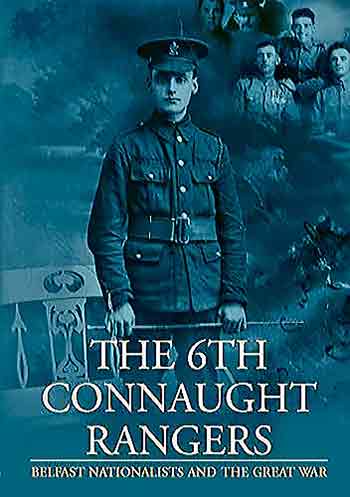
The Connaught Rangers (CR) that were stationed in India in 1920 at the height of the War of Independence became aware that other British Regiments, based in Ireland were terrorizing its citizens. Those based in Jullund began a protest against this behaviour, they flew the tricolour and refused to carry out their military duties. Within days their comrades in Solon joined in escalating the protest, also flying the flag, wearing green white and orange on their uniforms and singing Irish songs. I have no doubt they sang “Its A Long Way To Tipperary” the CR are credited with being the first Regiment to sing it during WW1 which was then taken up by the other BA Regiments.
When the men in Solon attempted to seize back their weapons in early July, two were killed and others wounded, and all mutineers were jailed under armed guard. This brought the Mutiny to an end resulting in over a dozen facing execution. Private James Joseph Daly, considered the leader was executed in November. All the others in the region of eighty were transferred back to England to serve out the remainder of their sentences.They received a dishonourable discharge, losing all pay and pension rights. While in prison they were harshly treated only being released without benefits, once the Free State was established. At which time the Regiment was disbanded. Of those that returned to Ireland some joined the Free State army, or New Police Force( Garda), others found it difficult to adapt to civilian life. All are unsung heroes whose sacrifices were for decades overlooked in the struggle for Independence.
In 1970 Daly’s body was returned (together with his fellow comrades, Patrick Smyth, and Peter Sears) to Ireland from India. He was given a full military funeral in his home town of
Tyrellespass,Co.Westmeath. Today there is now a monument to the Connaught Rangers in Glasnevin Cemetery, Dublin, where other muniteers are laid to rest.
Listowel - Co.Kerry
On the home front the British realized that the war was not going their way and that the IRA were gaining more and more authority as the year progressed
They instructed the army to oversee the RIC activities. This became very apparent in Listowel Co. Kerry when Lt. Col. Smyth (Irish man) was appointed by the British Cabinet as Divisional Police Commander for Munster, this also put him in charge of the military in the Province. When he gave orders , ““Shoot on sight “ and that they were also to be deployed as scouts for the army. RIC members led by Jeremiah Mee strongly objected, pointing out their role was to protect people and not shoot them, this led to a refusal to obey Smyth’s orders. Word spread to other Kerry units with many resigning their positions, thus reducing police numbers.They were not going to be used in a war against their own people. The action of these men was a major blow to the authorities and gave further encouragement to the IRA and its supporters in their struggle for freedom.
After the mutiny, Smyth went to Cork where he became an immediate target of the IRA. It was only a matter of time before its Intelligence network would identify Smyth’s location. The Cork and County Club (CCC) situated on the South Mall close to the city centre was a popular venue for British Army Officers. Sean Culhane, one of the Brigades intelligence officers, worked in the nearby Munster Arcade store just a few blocks from CCC. The Brigade had men and women watch the club for any sightings of Smyth. One of these was John Harrington employed by J.Mayne China Warehouse based on Patrick Street, Cork.John was an intelligence officer in H Company reporting to his Section head John Joe Hegarty (my Father). His brother Con, also of H company, worked in the City Hall close to CCC and was PA to Lord Mayor Terence McSwiney OC. of the Cork Brigade. Maynes supplied the CCC with fine china allowing John access to the club on a frequent basis.When Smyth was finally identified as a resident in the club, Culhane was given the all clear to assassinate him. He entered the building and found Smyth in the smoking room, addressing him saying ,”you said shoot on sight” “well you are now in sight” before he shot him where he sat. He also wounded another officer, a man he had sold socks to only recently, he was concerned that he would be identified but that never happened. As a result the Black and Tans ran riot in the City again that night. The killing also saw many RIC men resign their positions, further weakening the British grip on the country.
A few months later Culhane would travel to Lisburn and avenge the murder of Lord Mayor McCurtain, by executing the RIC officer responsible, District Inspector Oswald Swanzy. Vital Intelligence obtained at the railway station by volunteers working there, had identified some luggage that Swanzy was now living in Lisburn in the North of Ireland, after he fled Cork.(that’s another story).
Jeremiah Mee after resigning from the RiC became active in the Independence movement, dealing with leading figures such as Countess Markievvicz, helping Sinn Fein and former members of the RIC find work.The intelligence gathered from serving and former RIC members helped save many lives and turned the tide in the overall struggle for freedom.
The book by Conor McNamara ‘Defying Terror” which’deals with Mee in great detail.
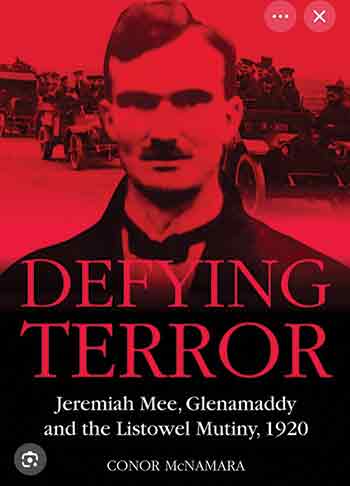
There is a nice human RIC story based on real life on YouTube ‘The Man in the Uniform’ produced by Maurice Dineen and supported by Cork City Council. ‘The Hegartys of The Laurels’ will be available also on YouTube, again produced by Dineen and Lisa O’Sullivan and supported by Cork City Council.
The role of intelligence gathering (especially by the women of Cumann na mBan) was vital not only in identifying spies, but in its role in bringing the British Government to the negotiation table,thus ending the War of Independence.
Memorials
and Commemorations
Similar to other Nations, Memorials and Annual Commemorations are important to us as a Nation. We take great pride in the actions and sacrifices of those that have gone before and the legacies they have left behind.
My first experience of these events was in 1960 when my father and his fellow comrades in H company erected a plaque and fired a volley over the home of American born Patriot Joe Murphy. (There is a planned event in his honor in Lynn Mass which I will report on at a later date.) This was followed a few years later with a memorial cross being placed at the Republican plot in St Finbarrs Cemetery. In1966 Commemorations to mark the 60th anniversary of the Easter Rising were held all over the country and continue to this day.
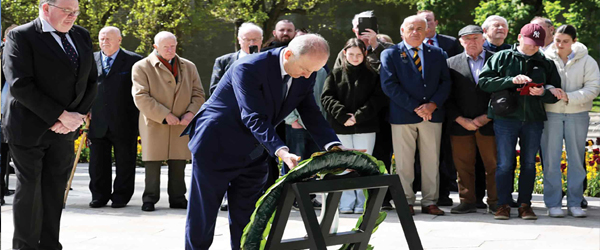
We are now taking more pride in our history with an Annual Commemorative day for all our brave Irish men and women.The main event is held at The Royal Hospital, Kilmaninham Dublin, a former British soldiers hospital. All faiths and creeds are represented at the service. The event includes the President of Ireland laying a wreath to the memory of all Irish men and women that served in the Armed Forces. It is always my privilege to receive an invitation from the Taoiseach to attend this televised ceremony.
Close by the hospital at Island Bridge are the Irish National War Memorial Gardens, which is dedicated to the 49,400 Irish soldiers who died during the First World War. These were neglected for decades until the Irish Government had them fully restored in the 1980’s. They are now considered one of the most stunning gardens in all of Europe.There is also an annual Remembrance Day in the gardens. Both venues are now very popular tourist attractions.
Many Cemeteries all around the country now have guided historic tours. in Dublin the best known is Glasnevin, in Cork by Finbarr Barry and his team at St Joseph’s, the first Catholic Cemetery opened in the City in 1830.
There are many memorials and sites around Ireland dedicated to the heroes of the War of Independence and Civil War worth visiting. The tallest memorial in the shape of the famous Round Towers, rests high in the Knockmealdown Mountains (on the border of Cork and Tipperary), dedicated to Liam Lynch on the site where he was shot, bringing the Civil War to an end.
On my most recent visit there I was accompanied by David Moran and David Ryan, Ryan’s grandfather Willie from Mitchelstown Co.Cork was an active Volunteer,and was responsible for Lynch joining the movement. He was also the person that brought the sad news of his death to Lynch’s mother. Seeing Ryan approach her home she knew her son was dead. Lynch’s last request was that he wished to be buried next to the hunger striker Michael Fitzgerald in Fermoy,Co.Cork.
When the Church refused to ring the bells at the service Willie’s sister locked herself in the BellTower and rang the bells to honour the dead patriot.
With better care and pride now being taken of our memorials they are attracting visitors from home and abroad and becoming a historic tourist attraction in their own right.
Acknowledging the
Vital Role of Women
The vital role of women during all our Nation struggles still needs to be highlighted more.
As a family we were honoured and privileged when the Cork City Council opened a Garden of Remembrance and Reflection in honour of my aunts Mamie and Nan Hegarty.
Recently when it became public that the Council were seeking suggestions for names of new Bridges,we suggested that one should be called -Cumann na mBan Bridge. Having lobbied Councillors on a cross party basis the vote was passed in its favour and Lord Mayor Fergal Dennehy, (who was in favour) had the pleasure of announcing the result. There is still a lot more to do.
www.hegartycollection.ie @hegartyjim
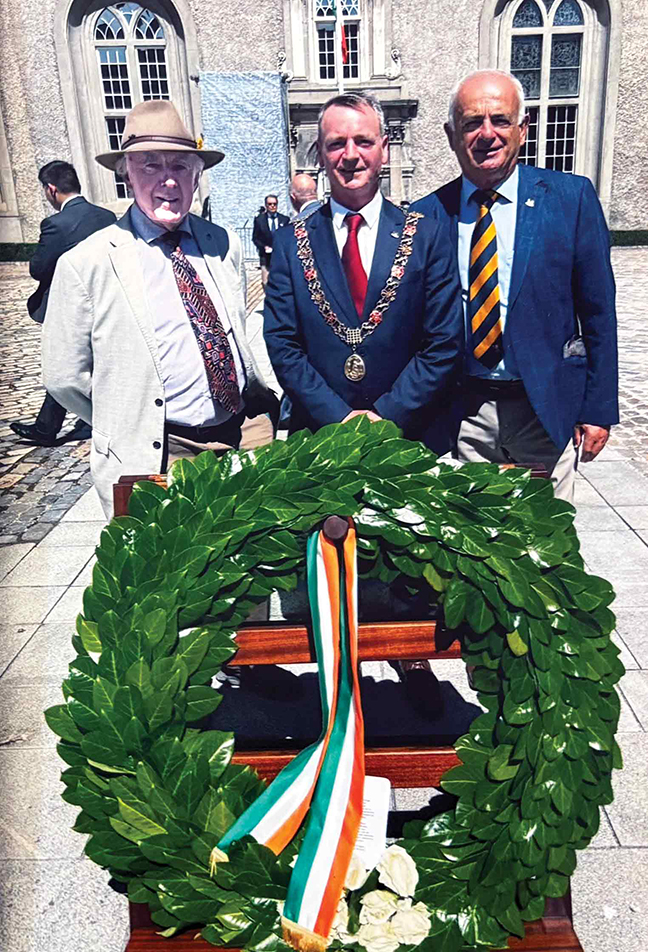
07-13-2025 National Day of Commemoration in Ireland. (l to r) Fergal Dennehy, David Moran; Lord Mayor Cork, Jim Hegarty; Author
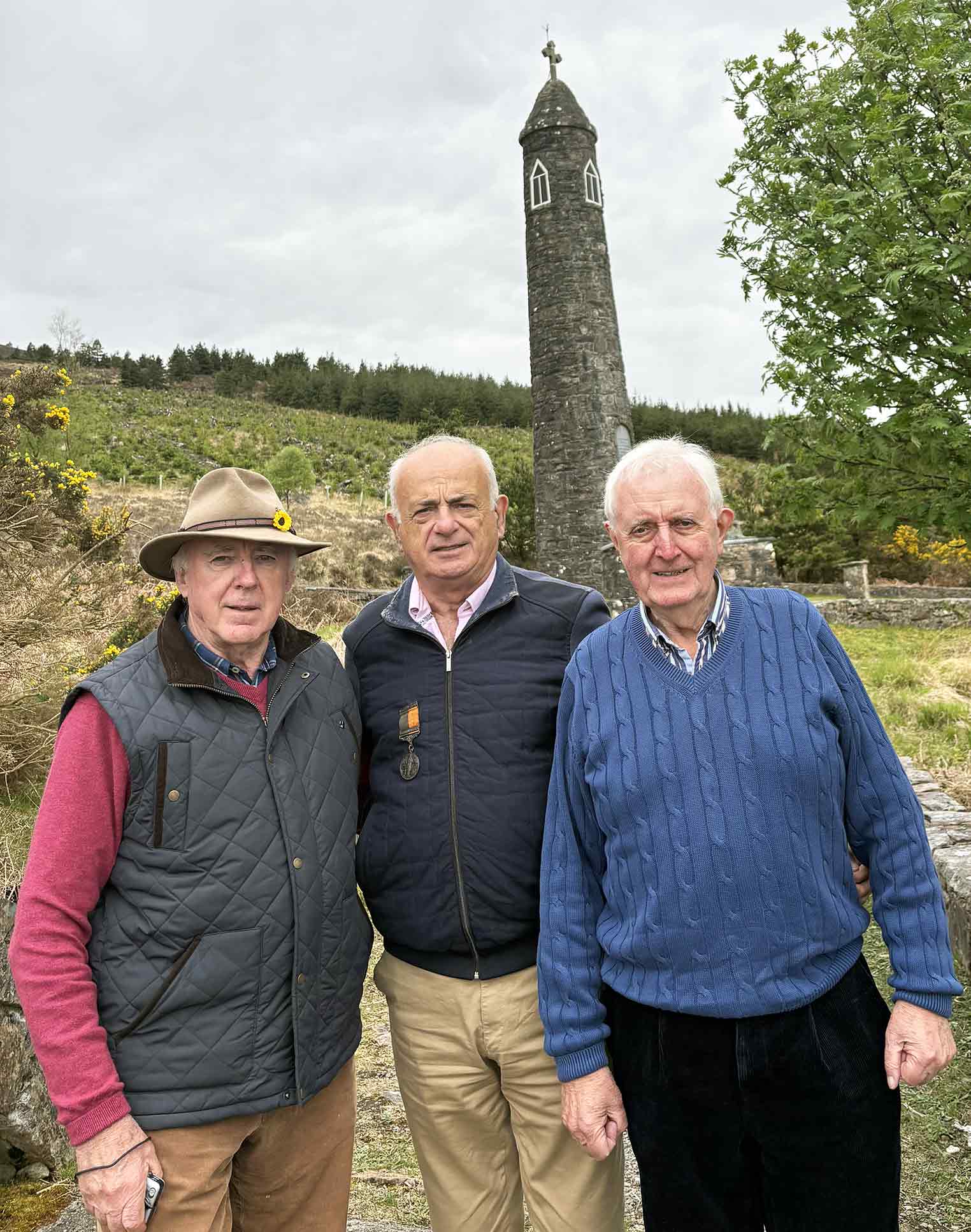
Liam Lynch Memorial: David Moran ,Jim Hegarty, and David Ryan