

By Emmett Fitspatrick
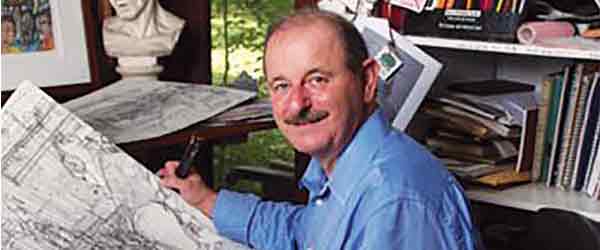
Artist Mark McMahon’s distinctive style is immediately recognizable in the watercolors, drawings, and murals that are featured in museums, schools, and private collections around the world. He has painted everything – and anything - from NASA space shuttle launches to national political conventions and scenes from Cuba, Mexico, and Ghana. And yet, at his heart, McMahon is a true-blood Chicagoan, cut from the same cloth as other local legendary artists – people like his parents Franklin and Irene McMahon - who made an impact far outside the city limits.
“The world is my studio,” McMahon reflects on his career. “I’m just a guy wandering around. I tried to fit myself in where I could, which ended up everywhere.”
If Mark ended up “everywhere,” then where exactly did he start? Naturally – this is the Irish American News, after all – his story can be traced to Ireland, and more specifically, County Mayo. There, in the middle of the Great Famine of the nineteenth century, his ancestors followed that great emigrant pilgrimage from Ireland to the United States, coming through New Jersey.
Fast forward one hundred years to post-World War II America, and his parents had settled in Chicago, living in the Edgewater Beach Hotel before moving to north suburban Lake Forest, where Mark and his eight siblings would grow up.
“We were a big Irish Catholic family,” Mark recalls, and when he and his siblings were not going to school at St. Mary’s Catholic School, they were roaming the woods and engaging in the arts. In fact, to say that the McMahons were an artistic family does not begin to capture the experience that Mark must have had in growing up surrounded by world-class artists and artistry.
Mark’s parents Franklin and Irene McMahon were a tour de force couple in the arts world, here in Chicago, across the nation, and throughout the globe. Between the two of them, they would find fame in journalism, travel writing, drawings, and film documentaries, to name a few, and garner too many public honors, Emmy and Peabody awards, and honorary degrees to list in one column. A simple Google search will provide a glimpse into the depth and breadth of the impact of the work of Mark’s parents.
Growing up in this environment, Mark and his siblings developed their own artistic talents and would each make their own impact on the arts world, which continues to this day. However, Mark’s life path was anything but a straight line.
“I started screaming on my first day of kindergarten,” Mark remembers, and that proved to be a prophecy of his academic career. As a fourth grader, he would take on his first job – as a stableboy at Onwentsia Club in Lake Forest during the golden age of polo there – and as a teenager he moved to Colorado to attend boarding school there. He would stay in Colorado to matriculate at Adams State University, where he earned an athletic scholarship to play soccer.
His greatest collegiate memories came not in the classroom or on the soccer fields, however, as he and two friends traveled to 48 states in his van over the course of six months as part of an education program that he developed with one of his professors. Their travels began with lunch with Studs Terkel and took them to places like Sing Sing prison in New York, the Kentucky Derby, and Kent State University shortly after the killing of four and wounding of nine unarmed college students protesting the Vietnam War. Mark and his friends would travel 250 miles per day and perform 5 interviews per day with people they met along the way. He keeps his diaries from that time in his Lake Forest studio in the basement of his house; they are ripe to be made into an engaging memoir of this time.
Life on the road proved exhilarating yet challenging for Mark and his friends, and they were not all together by the time their journey ended. In fact, Mark would end up moving back to Chicago to earn his degree at Loyola University of Chicago, but his adventurous spirit and belief in himself – and his art – were fully intact during his time serving as an apprentice at American Graphics Studio, one of several creative art agencies in the thriving Chicago advertising world at that time.
“I learned the trade at American Graphics Studio. I’d cut mats, help photographers, and study under talented illustrators,” Mark says of that time.
While he appreciated the experience he gained working in a large agency, Mark always knew that he was destined to be a freelance artist, so he embarked on a remarkable career that continues today. As he admits, “I was raised to be a freelancer.”
It did not take long for Mark to gain notoriety and acclaim for his drawings, which carry the distinctive style of his father. The scenes he depicts are wildly diverse and have taken him across the globe, including to the Emerald Isle. He returned to his ancestral homeland to help lead a trip for alumni of the University of Chicago, and he also has fond memories of traveling with his extended family to Northern Ireland.
As the media and advertising industries have transformed over the past four decades, Mark admits that he is a “rare bird” who has made a successful career doing what he loves.
On the topic of Mark’s loves, the story of his life would not be complete without including his wife Carolyn, whom he met through friends when she was working at the Bristol Renaissance Faire, and his parents would host groups of artists at their Lake Forest home. Naturally, Carolyn is an acclaimed artist herself; her medium is sculpture, and she uses ceramics, painting, bronze casting, metal, neon and slumped glass to create a diverse body of work inspired by nature and the cultures she has experienced in her travels. Carolyn also has her own Irish connection, having earned a master’s degree at the National College of Art and Design in Dublin.
Mark and Carolyn have passed along artistry genes to their three children: Drew, who works in metal frames, Meryl in ceramics, and Elyse in design.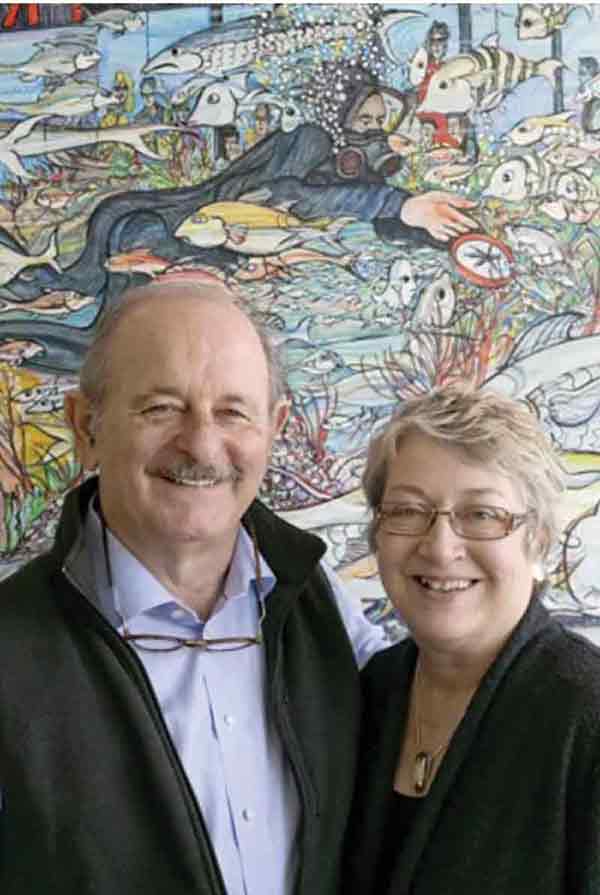
While Mark likes to say that his life has not been a straight line – in his words, “my whole life is filled with weird things happening, I don’t run in a pattern” – a closer reading reveals a few important themes that weave throughout his personal and professional lives. One, he is dedicated to his family, from his parents and siblings to his wife, children, and grandchildren; two, he has Chicago in his blood; three, he is an artist at heart, and, four, not to be underrated, he is a proud social activist.
This dedication to activism is another character trait that Mark picked up from his parents. His father gained fame for his coverage of the Emmett Till trial in Chicago, and he would go on to be heavily involved with the civil rights movement, bringing Mark and his siblings along to marches and other demonstrations in the 1960s and beyond. Fast forward to the twenty-first century, and Mark has carried on that legacy through his work, having traveled to Minneapolis to capture the scene during the aftermath of the George Floyd killing in 2020 and more recently depicting the No Kings protests in Chicago. 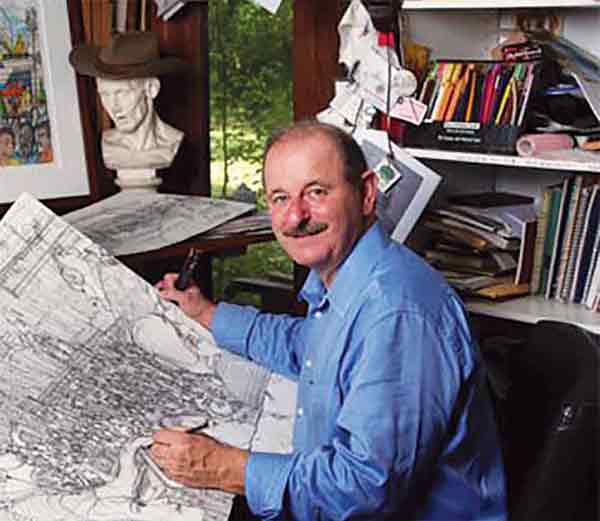
Mark likes to say that his drawing technique has become a part of the fabric of Chicago. For those of us who have had the privilege of interacting with him over the past half-century, we know that it is not just his art that has become a part of the fabric of the city. He and his family are living Chicago treasures.
Mark McMahon: Renowned Artist, Activist, and Chicago Treasure