By Patricia Skerrett Land
This is a story of the crossroads of spiritual blessings and human tragedy. The church of Old St. Patrick’s is the oldest public building in the city of Chicago having survived the Great Chicago Fire. Adorned in a style inspired by the Book of Kells, it has stood at the crossroads of life and faith for the urban Irish for over 150 years. It was at this crossroads of Adams and Desplaines Streets that two sisters from Ballyhahill found themselves on the night of October 30, 1962.
Peggy and Betty Walsh came to live in Chicago in 1946. Although they were nine years apart in age, they were close to each other. Employed as housekeeper and cook in rectories, they lived and worked together. Fr. John O’Brien, a parish priest in Chicago, remembered the laughter, the practical jokes and the connection to his Irish heritage they brought to his first assignment in 1950 at Resurrection Parish. “They really lit the place up,” he said, with their youth and high spirits.
On that crisp fall night a young man named Larry Vernon set out to do what he had done before all across the country. He got drunk and armed himself with not one but five knives looking to steal money from the nearest rectory. Creeping up to a first floor window, he shattered it and crawled through. The intruder found himself in the apartment of the Walsh sisters. Awakened by the commotion, the sisters ran screaming from their bedrooms into the living room where the intruder was ransacking drawers. Vernon stabbed Betty Walsh twice in the back. She collapsed at the foot of the stairway leading to the quarters of the pastor, Fr. Stephen O’Donnell; assistant rector, Fr. Mark Holihan, and three other priests. Peggy was ahead of her sister and pursued by Vernon who stabbed at her, inflicting wounds on her back and arms. She managed to reach the landing halfway up to the second floor when Fr. O’Donnell emerged from his room armed with a revolver. Fr. O’Donnell ran down the stairs and encountered Vernon brandishing a knife in each hand. The priest shoved him back and then fired when Vernon headed for him again. “I aimed at his legs; I didn’t want to kill him,” the priest said. While Fr. Holihan phoned the police, Fr. O’Donnell, a highly decorated World War II Army chaplain who had served under Gen. George Patton in Europe, held Vernon at gunpoint until the police arrived.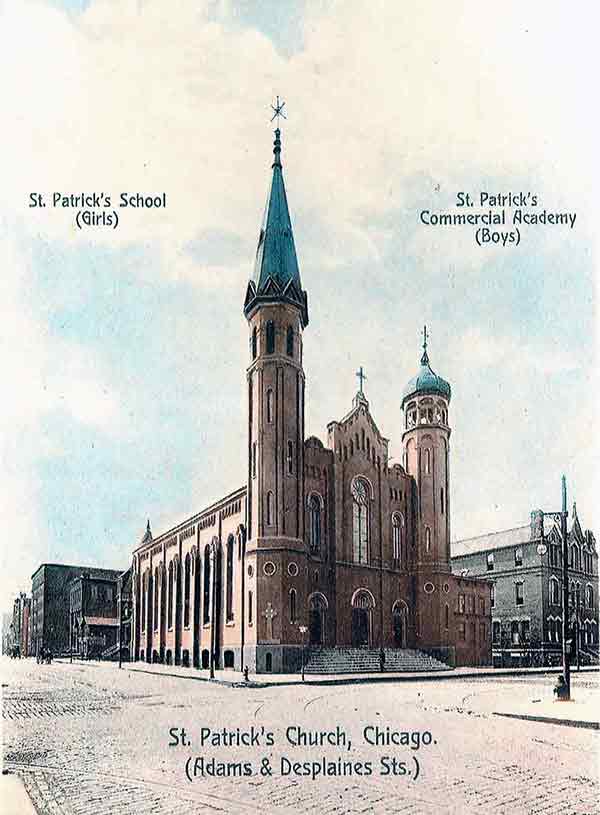
Betty died that night, but Peggy recovered and continued to work at Old St. Pat’s after recovering from her wounds. Fr. O’Donnell left her his Wisconsin home in his will and she eventually retired there. According to the newspapers of the day, Larry Vernon carried with him in addition to the five knives a couple of religious booklets. Written on a page in one of the books was a note dated just weeks before and signed by a minister in Reno, Nevada. It read,” Give Larry a chance—every man needs a friend.” He had arrived in Chicago just the day before from Texas. Vernon eventually received a sentence of 99 years in prison for the murder of Betty Walsh.
The Back Story - 50 Years Later
My interest in this event all came about when my cousin, Fr. Michael O’Connor OMI, was visiting us in Chicago in May of 2011. This was the first time he had come back after the death of my mother the year before. My mother, Ann Dalton Skerrett, was from Ballyhahill, County Limerick and had immigrated to Chicago in 1929. For the final three years of her life she lived at Holy Family Villa, an assisted living center. There she made many friends, including Fr. John O’Brien, also a resident. Fr. O’Brien loved to reminisce and tell stories of his days as a young priest in Chicago. He told my mother the story of the Walsh sisters. Although she did not recall the crime, she did remember them as girls from her school days in Ballyhahill.
When Fr. O’Brien met Fr. Mike and learned he was from Ballyhahill he told the story of the Walsh sisters. It was a story Mike had never heard before and felt that it should be shared. So long ago Larry Vernon’s path of violence took him to Old St. Pat’s and the Walsh sisters. Sometimes cultures clash, but more often they meet and cross in harmony and beauty like the Celtic knot that adorns the walls of Old St. Pat’s.
Old St. Pat’s in 1916. It looks much the same today.
A Murder at the Crossroads (about Old St Pat's) By Patricia Skerrett Land