

Negotiating An Ancient Conflict : Making Peace by George Mitchell Alfred A. Knopf 1999
By Sabina Clarke
This penetrating and insightful account by former Maine Senator George Mitchell chronicling his role in brokering the historic April 10th, 1998 Good Friday Agreement is not only a masterclass in conflict resolution but also a highly intimate personal account. It is like having a front row seat to history while illuminating the painstaking task Mitchell undertook as Special Envoy to the North that led after two and a half years of intense negotiations to the cobbling together of the historic agreement. I absolutely loved this book. It is a valuable piece of living history – and the task Mitchell undertook was prodigious. He calls it “the most difficult task I have undertaken.”
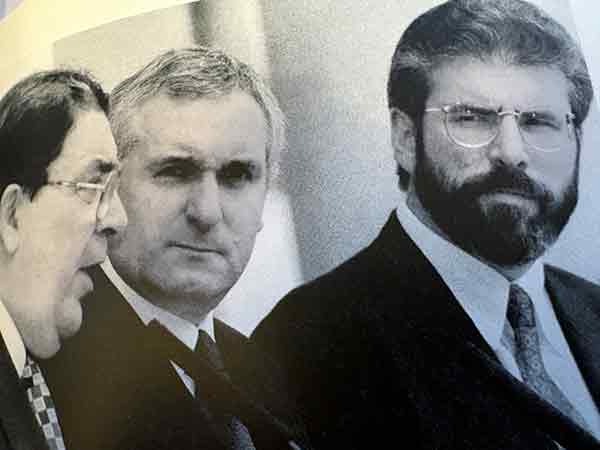
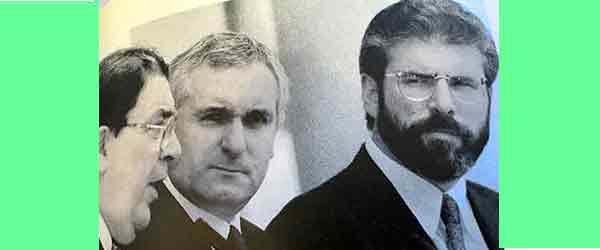
John Hume, Bertie Ahern, Gerry Adams
Mitchell’s first post in Northern Ireland was in 1995 when he was appointed Special Advisor to President Clinton on economic initiatives in the North. His Conference on Trade and Investment there was a success-- he thought he would never be back again. His time there gave him an understanding of the people. He was well liked by both Catholics and Protestants and grew fond of the people,
“Perhaps because they have seen so much death, they love life. They are warm and generous and have an earthy sense of humor. They love to eat and drink and they love to talk even more; how they love to talk!”
When appointed Special Envoy for the Peace Process, Mitchell traveled back and forth to preside over negotiations involving two governments – London and Dublin and 10 political parties to end centuries of conflict. It took 4 months just to get an agreed on agenda – and 9 months had passed with almost no progress made. And after meeting for a year and a half-- very little progress had been made.
Mitchell experienced strong resistance to his role as Chair of the talks from two of the unionist party leaders who stormed out in protest that an American was chosen to preside over them—Ian Paisley, Leader of the Democratic Unionist Party was most volatile in his objection. This was Mitchell’s first test--- his baptism of fire ; he remained calm and eventually prevailed.
From the outset, Mitchell made a promise to all parties that he would listen to anything they had to say and they could talk as long as they wanted—which he came to regret since he often had to listen to the same speeches over and over for hours on end. The talks were endless into the late nights and often interspersed with highly entertaining behind the scenes drama-- warring parties shouting accusations at each other and constant dramatic walk-outs by disgruntled participants. “ I wondered how I could get them to agree on anything of substance when they couldn’t even agree to sit together in the same room.”
As Chairman, he had to coddle, cajole and patiently listen to all the dissenting Northern Ireland parties –their ancient grudges, their laundry lists of grievances and their dramatic walkouts while doing a balancing act between the two governments. Mitchell comes across as likable, humble and impartial -- and possessing a good sense of humor and the patience of Job—the perfect pick for this incredibly complex role as arbiter of an intractable conflict. One of his strongest assets is his listening skills:
“I’ve been told I am a good listener; I got plenty of practice in Northern Ireland. For the two years of negotiations, I listened and listened. And then I listened some more. At times, it was interesting; at times it was entertaining. It was often repetitive, frustrating and deliberately quarrelsome. For hundreds and hundreds of hours, I listened to the same arguments over and over.” And he laughs recalling this.
Complicating the talks were the differences in goals-- the unionists wanted a continuation of the union keeping Northern Ireland as part of the United Kingdom with a strong majority running the Northern Ireland Assembly and the nationalists wanted just the opposite-- a united Ireland with North and South joined together in a single sovereign state.
All of this against the backdrop of the continuing threat of violence and daily threats of escalation which added to the urgency of reaching an agreement---since the Mitchell Principles--a commitment to democracy and non-violence-- were initially set forth as a requirement for all parties to participate in the talks.
Finally, on April 10, 1998 the historic Good Friday Agreement was ratified by all parties and both governments. For Mitchell it was, “ The realization of a dream that sustained me for three and a half years, the longest most difficult years of my life.” I remember the day well. My friend the center city Philadelphia attorney John Corcoran had a copy of the Good Friday Agreement delivered to me at work.
Months later, on the morning of October 16th, when the 1998 Nobel Peace Prize was announced, there was a feeling of disbelief among us that Sinn Fein President Gerry Adams was not included. Later in the day, I attended an event hosting Adams at the Union League in Philadelphia sponsored by the World Affairs Council. When in response to the question on everyone’s mind he said, “Peace is the prize” – you knew that he meant it. It was a powerful moment.
George Mitchell’s dream of ending an intractable conflict is now replaced by a new dream, he confides. His new dream is to take his young son Andrew to Northern Ireland “one of the most beautiful landscapes on earth” and watch the Northern Ireland Assembly at Stormont Castle in session discussing mundane topics on the day that peace is taken for granted.
Postscript: As a result of former Senator George Mitchell being named in the Epstein files more than 300 times there has been significant fallout. Mitchell’s legacy has been tarnished. He resigned from the Mitchell Institute and his name has been removed from scholarships. Queen’s University in Belfast removed the bust in his honor.