

By Emmett Fitzpatrick
For over two decades, the Boils have been a staple of the Chicago Irish music scene and are now one of the most well-respected and well-known Irish bands in the storied history of Chicago music. They are in the prime of their careers and have played all over the city and beyond, from traditional music sessions at Martyr’s to the Irish American Heritage Center and even a Metra train ride to Kenosha (more on that later). And yet, ask each of the three men who make up the band – Michael Austin, Jack Callahan, and Jim Conway - to reflect on what has made them stick together in a business not known for continuity, and they tell a similar story.
Conway: “We’ve never had an argument.”
Austin: “We’ve always had great communications without any drama.”
Callahan: “We’re always professional, and whether we play for 3 people or 3,000, we always make it a good time.”
The arc of the Boils’ success as an Irish music band naturally begins in Ireland, where each member calls his ancestral home. Conway’s lineage is most recent, as his parents were born in Ireland and met each other in Chicago. The roots of the band’s success can also be traced to its members’ stories of growing up in the Chicago area, which look remarkably similar.
Conway began playing music at the age of six, and he and his family would regularly travel back to Ireland, where he was exposed to Irish music through traditional sessions and family parties. Back in Chicago, he would take fiddle lessons at the Edison Park Field House, where famed Tommy Ryan of the Shannon Rovers taught, before learning to play the tin whistle and bodhrán, the latter from none other than Liz Carroll.
“I had the most amazing teachers,” Conway shares. “I’d travel all over the city to play music at céilís, competitions, and parties.”
As a teenager, however, Conway turned away from Irish music – as he puts it, “I wasn’t getting any chicks with the tin whistle” – instead playing folk music on his guitar and harmonica before being introduced to the Chicago blues scene as he entered adulthood. 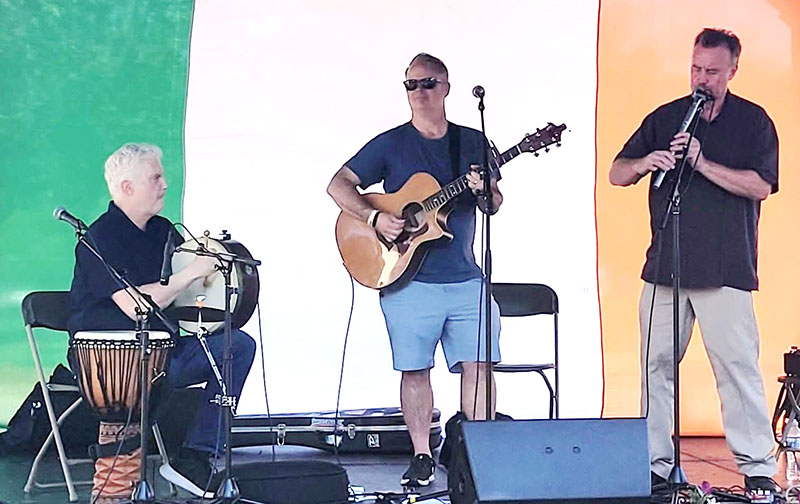
The Boils recently at the Long Grove Irish Festival
“I sucked up the blues scene,” Conway says, and along the way, he made a startling revelation: “I noticed that the music sounded a lot like my old penny whistle.”
Thus, in his early twenties, Conway returned to his Irish music roots, but by this time, he was melding his training in Irish music with his experience in the blues, becoming one of the few musicians playing Irish jigs and reels on his harmonica.
From that mashup, Conway’s distinctive sound was born, and music fans across Chicagoland – and beyond – have reaped the rewards of his work. He would join fellow musicians Mark McGowan and the late Jim McCandless to form a trio called Gan Ainm (Irish for “no name”), releasing a CD and becoming one of the first groups to play a regular gig at the Hideout. He began teaching at the Irish American Heritage Center and the Old Town School of Folk Music and sitting in with bands like the Drovers.
For his part, Austin grew up in Joliet, the youngest of seven children, and music was in his blood; his father had co-founded the Joliet American Legion band and his grandparents met by playing in a mandolin string band.
“I remember getting a Snoopy drum set when I was four years old,” Austin recalls. “My dad gave me drum lessons, and I was always playing music as a kid. As a teenager, I was more focused on sports, but when I graduated college, my brother gave me a tin whistle and I started taking lessons, which was really my foray into Irish music.”
Austin would go on to take lessons in the bodhrán, which he had noticed on a trip to Ireland as a high school student, and soon enough began teaching how to play that instrument at the Old Town School of Folk Music, like Conway.
Callahan was born on the southwest side and grew up in LaGrange. Like Conway and Austin, he was also surrounded by music from a young age.
“Music was in my family,” Callahan remembers. “My dad was a true music man, even though he was never trained, and my mom’s family in Connemara were traditional Irish singers. I started playing the piano in third grade, then picked up guitar and played in rock and blues bands in high school.”
The Old Town School of Folk Music also played an integral role in Callahan’s musical life, as it was the place where he, as a recent college graduate looking to explore his interest in Irish music, h took bodhrán lessons. His teacher? Michael Austin, of course.
“I was one of Mike’s first students,” Callahan says, and little did he know at the time the partnership that would blossom from those classes at the turn of the century.
Austin and Callahan became friends, attending shows and enmeshing themselves in the Chicago music scene. By this time, Callahan was in a band with Conway, and when that disbanded, they all eventually met back at Martyr’s, which hosted traditional music sessions every Monday,
“Everyone knew each other at Martyr’s,” Austin shares. “A few Mondays in a row, Jack and I would play together, and then we got Jim to join. The rest is history.”
The unique name of the band was the idea of Pat Finnegan, another Irish musician who was part of the band from the start and continues to fill in today. He thought it was a play on the family name of the Boyle’s with a slightly altered spelling.
Austin describes the musical style of the Boils this way: “We play Irish traditional music filtered through our musical pasts, which include rock n roll, blues, and other roots music. The three of us are fans of rock, blues, and folk, and at the same time we are trained in the traditional music of Ireland, for which we have total respect.”
This distinct sound is evident in each gig that the band plays, and over the course of two decades, they have played more than they can count, from local venues like Schuba’s to Irish bars and restaurants, from weddings to Irish festivals, and everything in between.
The Boils have managed to keep such a busy schedule without actively selling themselves, a rare feat in this age of constant self-promotion and filtered Instagram stories.
As Callahan says, “we just look for places to play, and gigs come to us.”
One venue where the Boils – primarily Conway – regularly play is not a well-known concert hall, pub, or Irish fest, however. Rather, it is a railway car of a Metra train bound for Kenosha, Wisconsin.
“It all started around 2008, when I was turning 40,” Conway recalls. “I planned a bike trip from Chicago to Milwaukee, with a stop in Kenosha. I ended up spending a magical night in Kenosha and was blown away by the town. When I got back to Chicago, I organized a regular ‘guys night out’ with my brothers and friends in Kenosha, where we’d take the Metra up and back from Chicago and always have a great time. Before long, some of our female friends joined us, we started playing music on the ride up, and the rest is history.”
https://www.facebook.com/theboils/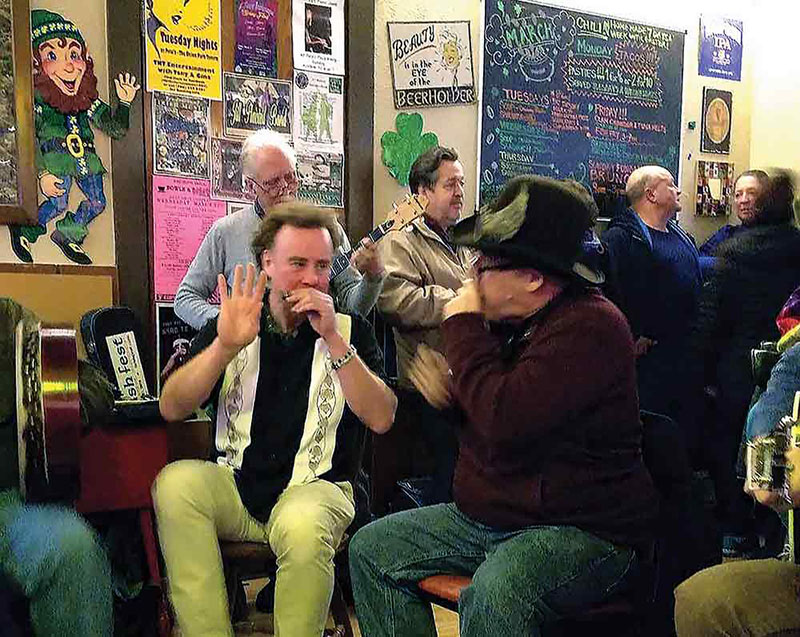
Taking the Metra to play Irish music at the Union Park Tavern in Kenosha, Wisconsin
The tradition continues with this special musical train ride several times per year. The concept is simple for those who want to join: bring a musical instrument or an interest in listening to music, hop on the train in or near Chicago, and enjoy the ride up to Kenosha, where you will disembark, walk a few minutes to Union Park Tavern, and enjoy an evening of food, drinks, and Irish music before taking the last train back to Chicago later in the night. Jim and his mates organize these trips to take place every few months; the next one will happen on Saturday, December 12, and all are welcome to join.
Despite the far-reaching impact of their musical careers, the three members of the Boils are not full-time musicians; they have each led successful careers in different industries. Austin is a freelance writer, having penned articles in publications like Esquire, GQ, and the Chicago Tribune, where he gained fame as the WINE WRITER. He has published short stories and poetry and currently edits the magazine for the Midwest Province of the Jesuits. Conway has been a building engineer for the better part of the last three decades, and Callahan has led a distinguished thirty-year career in logistics at CH Robinson.
Apart from their similar upbringings, pathways into the Irish music scene, and collaboration on a meaningful part-time passion, the three members of the Boils also share another important character trait: gratitude.
“We are fortunate to have begun our musical careers when we did, at the time of the Celtic Tiger when everyone was excited to be Irish again,” Callahan recognizes.
This is also not lost on Austin, who admits that for his grandfather, who emigrated from Ireland to the United States, “it was tough to be Irish.”
The Boils also express an appreciation for musically coming of age in Chicago, where they could learn from a legendary group of Irish musicians.
“I was trained from the old country, and I was around the greats, people like Johnny McGreevy and Liz Carroll,” says Conway. “At the time I didn’t realize how huge this was, but the universe started putting people into my circle, and as an adult I came to realize that, wow, this feels right. I’ve come full Celtic circle.”
As Austin reflects, “I feel a responsibility to carry on the tradition and guard the tradition. I feel honored to be part of the Irish Chicago tradition. I still look up to people like Dennis Cahill, Marty Fahey, Kevin Henry, and Katherine O’Connell. They’re the gold standard. I’m always looking to them for inspiration.”
Callahan proudly states that the Irish music scene in Chicago is unmatched in the quality and quantity of musicians anywhere in the United States, if not the world.
Into the pantheon of this storied Irish Chicago music world now stand the Boils, who continue to bring their distinctive sound wherever they play: pubs, concert halls, festivals, and, yes, Metra trains.
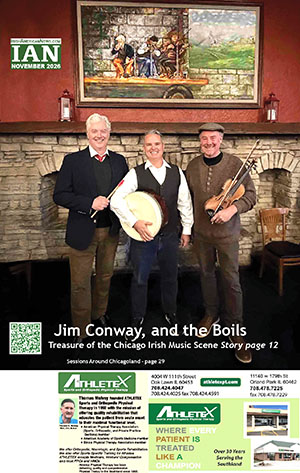
Catch the Boils at the popular 7pm Thursday Night Sessions at the Irish American Heritage Center. (l to r) Mike Austin, Jack Callahan, & Jim Conway
November 2026 cover photo, Irish American News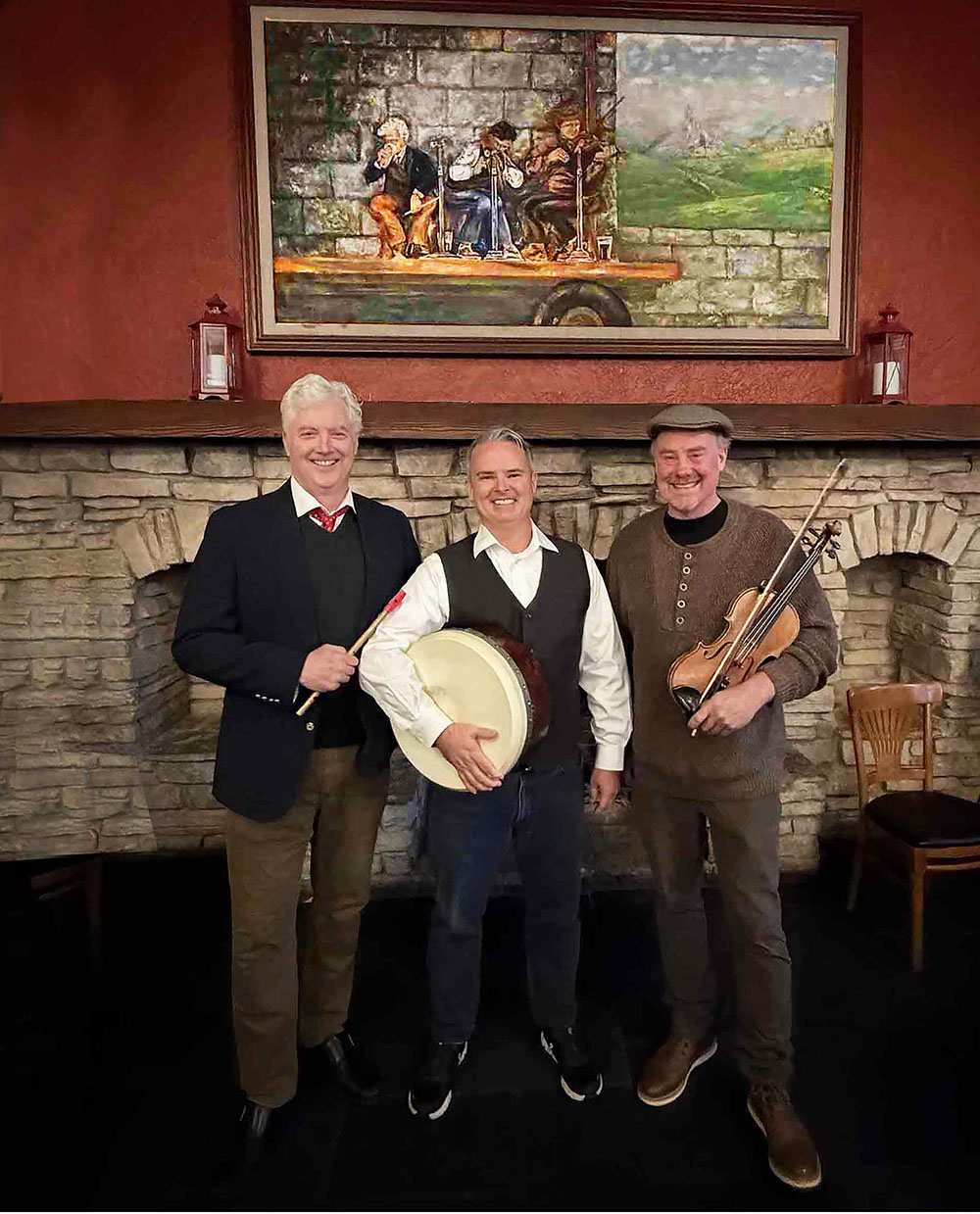
The Boils: A Treasure of the Chicago Irish Music Scene on Metra to Kenosha Wisconsin