




By Michael Washburn
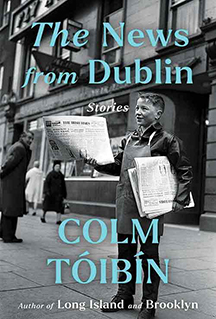
The News From
Dublin: Stories
By Colm Tóibín
Scribner, 304 pages
To adapt a saying of the boxer Tyson Fury, you can take a writer out of Ireland but you can’t take Ireland out of the writer. Or so The News From Dublin, the new volume of Colm Tóibín’s short fiction, will suggest to readers. Tóibín, a Wexford-born expatriate, has never lost sight of certain themes and concerns. In the nine tales collected here, characters who live in Ireland or have moved abroad grapple with how to cross sectarian, class, and ideological gulfs and navigate firestorms of hate and strife without compromising their principles or giving in to cowardice and sycophancy.
Often, the dilemma is most acute for those of his personae who have sought to reestablish themselves in a setting unlike Dublin’s drab working-class quarters. In “Five Bridges,” Tóibín introduces Paul, a divorced sad sack who, nearing fifty, ekes out a living as a plumber in the Bay Area without citizenship or a professional license. As he considers going home to Ireland, Paul relies on word of mouth for his gigs, unable to take on any but the most rote tasks. “He had his own way of unblocking pipes,” Tóibín writes. “Anything more complicated he left to others.”
Paul and his ex, Sandra, quarrel over custody issues. Not surprisingly, her new husband, Stan, does not think much of the plumber. Neither his station in life nor his status as a recovering alcoholic make it any easier to cross the gulfs and make friends with Stan, much less relate to his former Sandra or their daughter, Geraldine. Although he can take the girl to the park and on other brief excursions, Sandra is ever alert for reasons to fault Paul and lock him out of their lives, we learn. “He knew that he was being closely observed,” Tóibín tells us. “If he had once turned up late or failed to bring her back on time, or if there was even a whiff of beer on his breath, Sandra would have intervened.”
The world has little use for semi-employed former drunks who cannot decide whether to go back to Ireland or prolong their misery in the New World. The Paul of “Five Bridges” recalls the titular character in Brian Moore’s novel about a doomed quest for redemption, The Luck of Ginger Coffey. Like that antihero, Paul stumbles from one catastrophe to another, turning the quixotic idea of “Irish luck” on its head. As Tóibín’s story develops, the only character who shows any wish to give Paul a chance as a man or a father is the girl, Geraldine. When Paul, Sandra, Stan, and Geraldine go on a hiking trip in Marin County, the girl’s willingness, even eagerness, to solve a logistical problem by sharing a room with her father offers hope that attitudes and assumptions do not everywhere and always take root so early in life that the divisions making life unbearable must drag on.
In other stories in The News From Dublin, Tóibín presents characters who are not themselves Irish, yet face that familiar tension between the personal and political. They may have committed the faux pas of forming bonds with a member of a different camp against a backdrop of war and upheaval. In “Summer of ’38,” for example, we are smack in the midst of Spain’s civil war of 1936-1939. A young woman, Marta, lives in a town whose sympathies lie with the socialist government, not with the upstart General Franco or his fellow nationalists who first protect a dam in the vicinity, then come to take over the town. Marta grows involved with a man named Rudolfo after a chance meeting at a bar where people go to dance in the evening.
The fact that Rudolfo is on the nationalist side, and goes on to become one of Franco’s generals, might not matter so much if he did not get Marta pregnant. As she moves on to a more politically suitable youth named Paco, Marta tries to keep the father’s identity from everyone, but must live with a secret that contravenes the assumptions of all those in the town who lived through the traumas of a time when civil liberties were nil and disappearances occurred daily. Even decades later, no one will react well to the fact that a general on the other side of the bitter conflict fathered her child, the latter least of all.
Here is a variant of the kind of personal-is-political conundrum that played out in the late Alan J. Pakula’s 1997 film The Devil’s Own, in which an IRA operative living with a blue-collar Irish-American family in Staten Island – while pretending to be a construction worker – must decide, at the climax, whether the imperatives of his covert role or the bonds that have formed with his hosts are stronger. (Pakula leaves us to guess as to whether Brad Pitt’s IRA man collapses without shooting the father because of his conscience or a gunshot wound he just sustained.)
“Summer of ’38” offers further evidence of how Tóibín addresses Irish concerns when setting his work far afield. Even as it hints at more universal themes, “Summer of ’38” evokes the dynamics of a civil war that had overlap with social, cultural, and political currents in Ireland at the time. Indeed, the Spanish conflict was particularly concerning, and contentious, for people in Ireland. As Christopher Othen reminds us in his history, Franco’s International Brigades, the status of the Catholic church in Spain at the time, and the anticlerical ferocity of the Soviet-backed far left, made some Irish view events in Spain almost as an extension of their own battles. In Othen’s telling, Dublin newspapers of the time pushed the public’s buttons with lurid, shocking reports. “The Irish News printed twenty-seven pro-Franco editorials in the rising’s first five months, while atrocities against Spanish Catholics by left-wing militias were front-page news,” Othen writes. “Readers learnt bloody details of the thirteen bishops, 4,184 priests, 2,365 monks, and 283 nuns murdered in Republican territory” in just the early months.
In the final analysis, the tales set in North America or on the European continent – though rich and vivid – are moons orbiting the focus of Tóibín’s concerns, namely, the social divisions of Ireland herself. Stories such as “The Journey to Galway” “A Free Man,” and “The News From Dublin” are diverting, but the most powerful entry is “A Sum of Money,” in which a boy from a poor family named Dan, having learned from his father how to pick locks, puts the skill to use at his boarding school, starting by pilfering tiny amounts from lockers, then working his way up. On one level, it is hard not to pity Dan, whose parents show so little concern for him and who chafes at his status as compared with that of richer and more popular boys. On another level, the way he goes behind others’ backs and takes advantage of the ease of breaching what few safeguards of property exist at the school is repellent. Dan is not easy to like or dislike unequivocally, which may be just as Tóibín wished.
When one of the boys, Frank, witnesses Dan in the act of breaking into a locker, Tóibín leaves Dan and the reader to wonder whether Frank feels enough loyalty to the school and its stern authoritarians to report the crime, or will honor his own promise to Dan not to say anything. The tension escalates as other boys begin to have reasons to suspect Dan. The trip into town, intended as a break from routine and an opportunity for bonding and fun, turns out to be an ordeal for Dan because he cannot know whether others are ignoring him in the knowledge that he is a thief – from a socially unacceptable family, at that he is reading too much into things.
Though no reader of “A Sum of Money” will have trouble guessing where things are headed, Tóibín slyly sows doubts as to whether life at the school, where the highest reward most of the boys pine for is a trip into town to catch a game, and the social order that the school upholds, are enviable enough to view an expelled pupil as something akin to an angel cast out of heaven. To wax Nietzschean, maybe getting kicked out is the most elevating expression of Dan’s repressed will to power.
The News From Dublin is the work of a writer of international stature who came of age in a world of seemingly unbridgeable divides, and who knows full well that profound questions are of greater value than comforting answers.
Available on Amazon and elsewhere.